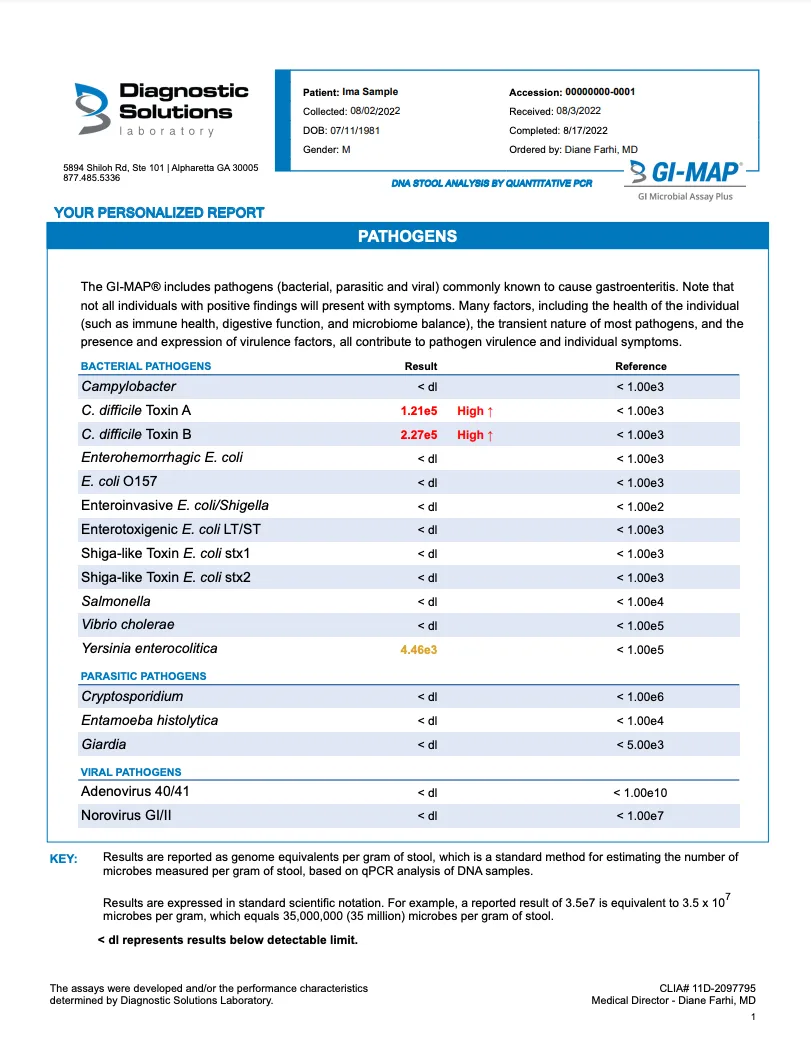
1. Pathogens
Bacteria, parasites & viruses that can cause infectionHelicobacter pylori is a bacterium that colonizes the stomach lining. It is extremely common and often causes no symptoms — but when certain virulence-factor genes (such as CagA and VacA) are present, it is associated with a higher risk of gastritis and ulcers. The GI-MAP™ uses qPCR to both quantify H. pylori and report which virulence factors are present.
Why it matters: the combination of quantity and virulence factors helps your practitioner decide whether — and how — to address it.
These organisms can cause acute or lingering gastrointestinal infections. qPCR detects their DNA (and, for C. difficile, its toxin genes). A positive result needs clinical interpretation; DNA detection alone does not establish that an organism is causing illness.
Why it matters: a detected enteric pathogen should be reviewed promptly with your practitioner or physician.
The GI-MAP™ screens for protozoa and parasites. Some (like Giardia and Cryptosporidium) are clear pathogens; others (like Blastocystis hominis) are common and their significance depends on your symptoms and overall picture.
Why it matters: a clinician should assess the finding alongside symptoms and consider confirmatory testing where appropriate.
Selected viral targets are reported. A result does not rule every viral cause in or out; interpret it with symptoms, timing and the test’s limitations.
2. Normal & Beneficial Bacteria
Keystone microbes that support a healthy gutAkkermansia helps maintain the protective mucus layer that lines the gut and is associated with metabolic health. A low level is one signal a practitioner uses when assessing gut-barrier support.
Why it matters: low keystone species can point toward dysbiosis that diet and targeted support may help rebuild.
One of the gut's most important butyrate producers. Butyrate is a short-chain fatty acid that fuels colon cells and has anti-inflammatory effects. Low levels may mean reduced short-chain-fatty-acid production.
Familiar beneficial genera that support digestion and help keep opportunists in check. Seeing them in a healthy range is reassuring.
3. Opportunistic & Overgrowth Organisms
Normal in small amounts — a problem in excessMethane-producing archaea. When elevated, they are often discussed in the context of constipation-predominant symptoms and methane-related SIBO/IMO.
Why it matters: an elevated result is a clue your practitioner correlates with bowel-habit symptoms.
These opportunists are normal in small numbers. They can contribute to symptoms when they overgrow — which often happens when beneficial bacteria are low.
4. Fungi & Yeast
Candida and other yeastsCandida is a common yeast that lives in the gut. The GI-MAP™ quantifies it by qPCR, so a practitioner can judge whether the amount present — alongside your symptoms — suggests overgrowth worth addressing.
5. Intestinal Health & Digestion
Inflammation, immunity, digestion & the gut barrierCalprotectin is a protein released by neutrophils (immune cells) in the gut and is a widely used marker of intestinal inflammation. Clinically it helps distinguish inflammatory from functional conditions and is used to monitor inflammatory bowel disease.
Why it matters: an elevated calprotectin warrants clinical correlation with your practitioner or physician — it is a signal, not a diagnosis.
sIgA is the gut's first-line mucosal antibody. A high value can reflect an active immune response in the gut, while a low value can reflect reduced mucosal defense.
Elastase-1 reflects how much digestive enzyme your pancreas is producing. A low value can suggest reduced enzyme output that may affect how well food is broken down.
A bacterial enzyme that influences detoxification and the recirculation of estrogens. Elevated activity is something practitioners consider in hormone- and detox-related discussions.
Zonulin regulates the tight junctions between intestinal cells, so it is used as a marker of intestinal permeability ("leaky gut"). It is included on the GI-MAP™ + Zonulin panel rather than the standard panel.
Why it matters: if gut-barrier integrity is a priority for you, choose the + Zonulin add-on when ordering.
Detects blood that isn't visible in the stool. A positive result always needs evaluation by a medical provider.
Reviewed by
Madison Ordway, FDN-P
Functional Diagnostic Nutrition Practitioner specializing in gut health, hormone balance, and mineral optimization. Madison uses GI-MAP™ testing in her work with clients and has been featured in US Insider, Women's Journal, and The Science Times.
How results are measured. Every marker above is analyzed by Diagnostic Solutions Laboratory using quantitative PCR (qPCR) — a DNA-based method that counts how much of each organism is present (not just present/absent) and measures intestinal-health markers from a single stool sample. Marker explanations reflect established functional and clinical literature; for a deeper dive, read What Is the GI-MAP™ Test? and How It Works.